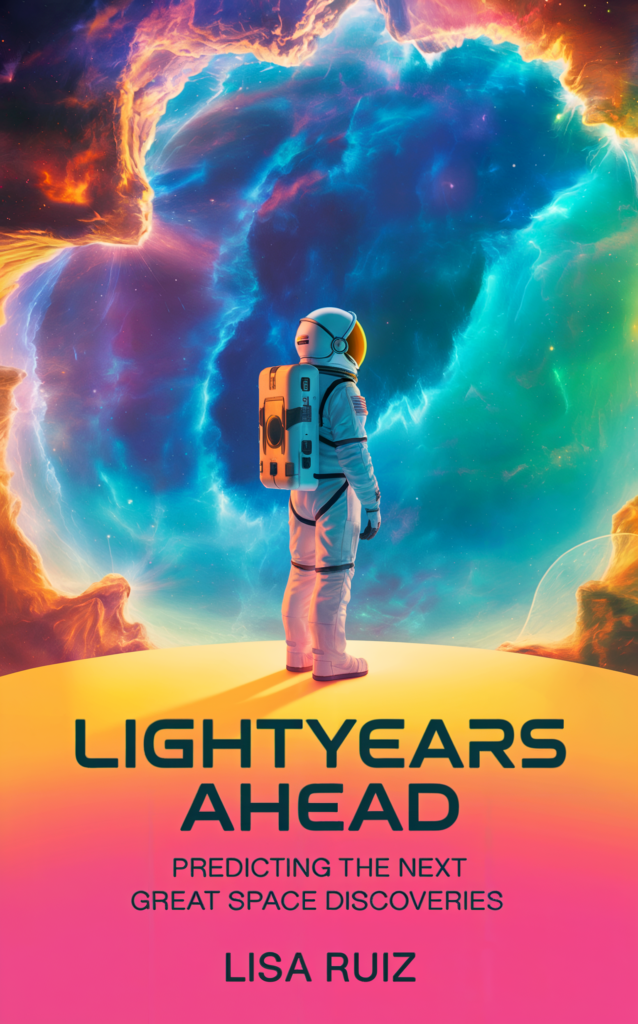
Checking out the Infinite: A Deep Dive into Lisa Ruiz's Lightyears Ahead: Predicting the Next Great Space Discoveries
Few books handle to combine visionary thinking, rigorous science, and philosophical depth rather like Lisa Ruiz's Lightyears Ahead: Predicting the Next Great Space Discoveries. At a time when humankind teeters between planetary fragility and cosmic aspiration, this extensive 50-chapter tour de force offers not just a roadmap to the stars but a mirror in which we might look who we genuinely are-- and who we might end up being. With lyrical clarity and intellectual accuracy, Ruiz crafts a multidimensional exploration of what lies beyond Earth and how that mission improves us at the same time.
This is not a speculative fiction novel or a dry academic text. It is something rarer: a completely fleshed-out work of science-based futurism that checks out like a love letter to the universes, wrapped in important insight and ethical reflection. Covering everything from AI and alien contact to quantum paradoxes and the future of education in space, Lightyears Ahead is a strong, spectacular synthesis of where science is going and why it matters more than ever.
Lisa Ruiz: A Cosmic Communicator
Before delving into the abundant contents of the book itself, it's worth recognizing the distinct voice behind it. Lisa Ruiz brings to her composing an unusual blend of clinical acumen and literary sensitivity. Her background in astrophysics and science communication appears in her positive handling of complex subjects, however what raises her work is the psychological intelligence and narrative artistry she brings to each subject.
In Lightyears Ahead, Ruiz shows herself not merely as an interpreter of science however as a thinker of the future. Her prose doesn't simply describe-- it stimulates. It does not merely hypothesize-- it interrogates. Each chapter is written not only to notify, but to awaken the reader's interest and empathy. The result is a work that feels both deeply personal and expansively universal.
The Structure of Vision: A 50-Chapter Odyssey
One of the most excellent accomplishments of Lightyears Ahead is its structure. The book is divided into fifty stand-alone yet interconnected chapters, each taking on a specific facet of area expedition or future science. This format makes the book both extensive and digestible. You can read it cover to cover or jump into a chapter that catches your eye, whether that's on rogue planets, quantum communication, or the ethics of terraforming.
The flow of the chapters is carefully orchestrated. The early sections ground the reader in the existing state of space science-- where we are and how we got here. From there, the book branches out into increasingly speculative yet evidence-informed area: exoplanetary research studies, biosignature detection, alien contact circumstances, gravitational wave astronomy, quantum entanglement, and beyond. It culminates in reflections on the philosophical and spiritual implications of the journey-- what Ruiz appropriately refers to as the increase of post-humanity and the evolution of cosmic principles.
Area, Not Just as Destination-- But as Transformation
Among the core strengths of Lightyears Ahead lies in its thesis: that space is not simply a destination, however a catalyst for improvement. Ruiz does not fall under the trap of treating space expedition as an engineering problem alone. Rather, she frames it as a human venture in the inmost sense-- a test of our imagination, ethics, versatility, and unity.
In chapters like "The Limits of Human Senses" and "Artificial Superintelligence in Space," Ruiz explores how venturing beyond Earth will necessitate not simply physical modifications, however shifts in consciousness. How will we perceive time when signals take years to take a trip in between worlds? What occurs to identity when minds can exist across machines or synthetic bodies? What becomes of culture, morality, and memory when born under synthetic stars?
These aren't hypothetical musings; they are the extremely genuine questions that will form the societies of tomorrow. Ruiz handles them with intellectual rigor and a reporter's ear for relevance, grounding her futuristic situations in today's clinical developments while always keeping the human experience front and center.
Hard Science, Soft Wonder
Make no mistake: Lightyears Ahead is soaked in difficult science. Ruiz dives into complex subjects like gravitational lensing, quantum decoherence, biosignature spectroscopy, and the Kardashev scale without flinching. However she does so in a way that stays available to non-specialists. Her talent lies in distilling the essence of a theory without dumbing it down-- welcoming readers to stretch their minds without feeling overwhelmed.
Yet the science never ever overshadows the wonder. Ruiz composes with a poetic sense of awe, frequently drawing comparisons in between ancient mythologies and modern missions, between early stargazers and today's astrophysicists. In doing so, she advises us that science is not separate from creativity-- it is its most disciplined expression. The marvel of area, she recommends, lies not simply in its distances or threats, but in its power to change those who attempt to seek it.
The Exoplanet Renaissance: Our New Celestial Neighbors
Amongst the standout areas of Lightyears Ahead is Ruiz's treatment of the exoplanet revolution-- a scientific watershed that has turned thousands of far-off stars into possible homes. In chapters like The Exoplanet Explosion, Earth 2.0, and Super-Earths and Mini-Neptunes, she guides the reader through the history, techniques, and significance of finding worlds beyond our solar system.
What sets Ruiz apart from other science communicators is how she merges technical insight with cultural and emotional resonance. These are not simply data points in a catalog. They are distant coasts-- mirror-worlds and odd spheres that might harbor oceans, skies, and maybe even life. Ruiz thoroughly describes how we identify these worlds, how we evaluate their environments, and what their large abundance tells us about our location in the cosmos.
She doesn't stop at the science. She asks what it implies to find a real Earth twin-- not just in terms of habitability, but in terms of identity. Would such a discovery comfort us, challenge us, or change us? Could another world end up being a spiritual homeland, a cultural canvas, or a moral base test? These questions linger long after the chapter ends.
Alien Contact: Fact, Fiction, and Future
In among the most gripping segments of the book, Ruiz addresses the tantalizing question that has haunted astronomers, theorists, and poets alike: are we alone?
Her conversation of biosignatures and technosignatures-- scientific terms for signs of life and innovation-- is grounded in innovative research study, however she goes further. She checks out the probability and paradoxes of alien life with intellectual honesty, noting the alluring silence that persists despite years of listening. Ruiz presents the Fermi paradox, the Drake formula, and the zoo hypothesis with accuracy, but doesn't utilize them simply to display understanding. Rather, she uses them to build a nuanced meditation on what alien life may look like-- and how we might respond to it.
The chapters The Next Alien Signal, Life in the Clouds of Venus, and Microbial Martians reflect a series of situations, from microbial fossils to device intelligence, from uncertain chemical traces to apparent beacons. Ruiz does not sensationalize these ideas. She patiently unpacks the science and then raises the ethical stakes: What are our duties if we discover alien life? Do non-Earth organisms have rights? Are we prepared for the psychological, political, and theological shocks that contact would bring?
Checking out these chapters is not simply entertaining-- it seems like preparation for a truth that could arrive within our life time.
Space and the Human Condition
What elevates Lightyears Ahead from an excellent science book to an extensive work of cultural commentary is its exploration of how space improves the human condition. This is most apparent in chapters like Living Off Earth, Education Among the Stars, Cosmic Ethics, and Religions of the Cosmos. These chapters move the focus from telescopes and trajectories to hearts and minds.
Ruiz imagines how future generations will grow, learn, love, and pass away beyond Earth. She thinks about the psychological pressure of isolation, the cultural reinvention that comes with off-world living, and the methods which spiritual traditions might develop in orbit or on Mars. Rather than daydreaming about paradises, she acknowledges the genuine obstacles that lie ahead: governance without precedent, education without gravity, and morality without clear maps.
In her discussion of religion in space, Ruiz doesn't mock belief-- she honors its determination and advancement. She acknowledges that area might agitate traditional cosmologies, but it also invites brand-new types of reverence. For some, the vastness of area will strengthen the lack of magnificent purpose. For others, it will end up being the greatest cathedral ever understood.
It's in these chapters that Ruiz's unusual voice shines brightest-- one that embraces intricacy, appreciates unpredictability, and elevates wonder above cynicism.
Artificial Minds Among destiny
As the book moves much deeper into speculative area, Ruiz checks out the rapidly merging frontiers of artificial intelligence and area travel. The chapters Artificial Superintelligence in Space, Swarm Intelligence, and The 100-Year Starship read like a thrilling manifesto for a future in which intelligence is no longer restricted to biology.
Ruiz describes the possible situation in which makers-- not people-- end up being the primary explorers of the galaxy. Efficient in withstanding deep space travel, operating without nourishment, and evolving quickly, AI systems might precede us to distant worlds or even outlast us. But Ruiz doesn't treat this development as merely mechanical. She interrogates the ethical questions that develop when synthetic minds start to represent human worths-- or differ them.
Could an AI be humankind's very first ambassador to another civilization? If so, what should it state? What does it indicate to develop minds that believe, feel, and act individually from us? These are not concerns for future thinkers. As Ruiz programs, they are choices being made today in labs and code repositories all over the world.
The clearness with which Ruiz articulates these concerns, and her rejection to lower them to technophilic dream or alarmist panic, marks her as one of the Get answers most well balanced futurists composing today.
Completion-- and the Beginning
The last chapters of Lightyears Ahead are both sobering and exciting. In The End of the Universe, Ruiz lays out the cosmic timelines of entropy, collapse, and expansion. The science is chilling, and yet her tone stays deeply human. She frames these remote occasions not as armageddons, but as invitations to cherish what is fleeting and to imagine what may follow.
In the closing chapter, Lightyears Ahead, Ruiz brings the journey cycle. It is a poetic and confident meditation on everything the book has covered: the power of science, the need of cooperation, the advancement of identity, and the pledge of the stars. She ends not with a forecast, however a plea-- not for certainty, but for curiosity. Not for supremacy, but for obligation.
It's a fitting conclusion for a book that has never looked for to enforce a vision, but to light up lots of.
A Book That Belongs to the Future
Among the highest compliments that can be paid to any work of nonfiction is that it feels ahead of its time-- and Lightyears Ahead earns that distinction with grace. It is a book composed not just for today minute, but for generations who will look back at our age and wonder what we believed, what we dreamed, and how we got ready for what followed.
Lisa Ruiz has actually developed more than a book. She has crafted a kind of philosophical star map-- a multi-dimensional framework for thinking of the deep future. In doing so, she joins the ranks of Carl Sagan, Arthur C. Clarke, Michio Kaku, and Yuval Noah Harari, authors who have actually handled the ambitious job of merging extensive scientific thought with a vision that talks to the soul.
What identifies Ruiz's voice is her deep grounding in principles and compassion. Even as she dives into the speculative and the strange, she never loses sight of the ethical implications of our technological trajectory. This is a book Get to know more that appreciates science without worshipping it, celebrates progress without overlooking its risks, and speaks to both the reasonable mind and the browsing spirit.
A Book for Many Kinds of Readers
Lightyears Ahead is incredibly versatile in its appeal. For space science lovers, it offers in-depth, present, and accessible explanations of whatever from exoplanet detection methods to gravitational wave astronomy. For futurists and technologists, it offers thought-provoking analyses of AI, post-humanism, and long-lasting civilization design. For thinkers and ethicists, it is a goldmine of concerns about identity, firm, and morality in a significantly transformed future.
Even those with little background in space science will discover the book friendly. Ruiz's design is inclusive-- she explains without condescending, theorizes without overcomplicating, and welcomes readers into a discussion instead of delivering lectures. The tone remains confident but measured, passionate however exact.
Educators will discover it indispensable as a mentor tool. Students will find it inspiring as a profession compass. Policy thinkers will discover it vital reading for comprehending the long-term stakes of spacefaring civilization. And general readers will find themselves swept into a story not just about the stars, however about the future of being Click here human.
Why You Should Read Lightyears Ahead
In a time of international uncertainty, planetary crises, and speeding up modification, Lightyears Ahead offers a vision that is both extensive and grounding. It advises us that the difficulties of our world do not lessen the significance of looking external. On the contrary, they make it essential.
Area is not a diversion from Earth's problems. It is a context in which those issues discover their true scale-- and where services that as soon as seemed impossible might end up being inevitable. Lisa Ruiz shows us that checking out area is not See offers about escapism. It is about engagement: with science, with ethics, with the future, and with each other.
To read this book is to reawaken one's sense of scale-- not just physical scale, however ethical and temporal scale. It is to find a type of intellectual guts that dares to ask the biggest concerns, even when the responses are not yet clear.
What are we here for? Where can we go? What must we become in order to get there?
These are not idle questions. They are the fuel that powers not just rockets, however transformations of idea.
Final Reflections
In Lightyears Ahead: Predicting the Next Great Space Discoveries, Click for details Lisa Ruiz has produced an impressive achievement: a science book that is also a work of literature, a roadmap that is also a reflection, and a projection that is likewise a call to awareness.
This is a book to be checked out gradually, savored chapter by chapter, and returned to again and again as new discoveries unfold. It will stay pertinent as telescopes grow sharper, objectives grow bolder, and mankind edges closer to the stars. It is not just a snapshot of today's space science-- it is a philosophical foundation for the civilizations that will emerge lightyears from now.
For those who dream of what lies beyond the Earth, who wonder what it indicates to be human in an interstellar future, and who long for a vision of expedition that is both bold and deeply accountable, Lightyears Ahead is necessary reading.
It belongs on the shelf of every curious mind, every bold thinker, and every reader who knows that the story of humanity is only just beginning.